Friday, 2 November 2012

Ghostly tales & nightgowns


 I have been to an auction in County Durham this week - I can get there by motorway but the scenic route over the hills and moors is so much nicer (provided you don't get stuck behind a tractor!).
Lovey autumn colours too and lots of wildlife; sheep, deer, rabbits and pheasants were all spotted on the way. 

At the auction I was only successful with one lot but it was full of Victorian white cotton nightdresses and maid's aprons.


I was told that the vendor of the lot had originally acquired the clothing in a trunk at a sale of some of the contents of Stanhope Old Hall. 


Stanhope Old Hall, a medieval manor house on the edge of the North Pennine village of Stanhope, County Durham, has long had a spooky reputation. Local legend has it that, during the Middle Ages, a young engaged couple entered the house and disappeared, only to be found years later under the floorboards — two skeletons holding hands.

One resident claimed to have so many strange experiences whilst living in the house that they called in the Paranormal Society. When they visited they reported sudden temperature drops, sightings of an old grey lady, ghostly orbs captured on film and visions of red-robed monks in the boiler room. (During Henry VIII’s dissolution of the monasteries, monks hid in the basement here.)  I wonder if any of them had been wearing one of my white nightgowns?  Definitely a very seasonal tale as Halloween was just two days ago!

I also found these images on the internet showing just a small range of the nightwear that was available in Victorian times.

 I love the advert for face powder in the sheet below - she must have needed a great deal of coverage as the box is the size of a drum!

I have included the link below so that you can see more of these catalogues if you want to take a look.
http://www.squidoo.com/free-digital-collage-sheets-catalog-pages


Sunday, 14 October 2012

Busy, busy, busy!

Apologies for not posting for a few weeks now but I have been busy with buying and selling (and with family stuff!).  I have had some contacts lately through this blog and through Ebay that have proved interesting in a number of ways. Someone (you know who you are!) contacted me from a town up the Northumberland valley - Haltwhistle - to ask if I would like to look (and buy) some textiles that they had accumulated. 


Although trains still go through the station at Haltwhistle, the name "Haltwhistle" is not derived from the railway line but it is thought that "Halt" probably means high point of land and "twistle" relates to two streams or rivers. It is a pretty town not far from Hadrians Wall - probably the best known tourist landmark in the North of England


           Haltwhistle also has a spectacular bridge for the trains to travel over!

So my invite was to look at some textiles at "J's" house.  And what an interesting collection! From blankets and eiderdowns to  tea towels and top hats. And a lot of eiderdowns and quilts that weren't for sale - maybe another time?

So on Ebay this week and next are some of my haul

                                                    Collapsible top hat.

                  Some beautifully hand embroidered tablecloths and cushion covers

One eiderdown, but I do have some more in my stockroom to list soon too. They are perfect for the winter.


Tuesday, 7 August 2012

Patchwork quilts

 To follow on from last months item on Durham quilts it seems appropriate to show some patchwork quilts that I have for sale at the moment.  The hexagon quilt above (Grandmothers garden design I think) is quite old - probably dating to the early 1800's and has many old chintz cotton fabrics.


This one is at the other end of the antique scale as it dates to around the 1930's to 40's judging from the fabrics and colours.  It has a lovely pin wheel design and a very charming ditsy country floral fabric to the reverse


This one combines two different patchwork designs and plain fabrics in a type of strippy Durham quilt/patchwork quilt.  This is in excellent condition for a quilt made about 100 years ago. Many of the quilts with a strong red colour to the fabrics have damage as some types of  dye used to create red caused the cotton to rot after time.


And finally, this is a lovely Folk Art style quilt - it looks like the American quilts but it was bought from a Weardale house where it had been in the family for many years. The birds have a cheeky look about them! This quilt has a variety of different shapes used within the paytchwork - squares, tiny squares, triangles, octagons, florals. 

All for sale this month on Ebay so take a look to see all the photos before they are sold!

Sunday, 15 July 2012

Durham quilts


I have recently had a number of customers asking about the origins and history of Durham quilts so a short potted history seems appropriate. 

Quilted fabrics start to appear in England in the early 18th century. A set of bed furnishings, dated around 1708, at Levens Hall in Cumbria, is the earliest known example of quilted patchwork in Britain. As in most parts of the world, patchwork and quilting were originally two distinct techniques, serving both functional and decorative purposes. In poorer households, patchwork would have been an important way of prolonging the life of fabrics, which in pre-industrial days were labour-intensively produced in the home and would only have been discarded as a last resort. More affluent homes, tended to own highly decorative quilts and quilted clothing which were partly designed to display the wealth and importance of their owners. Quilts are generally made with two layers of fabric sandwiching a layer of padding /wadding/batting in the centre. In Durham quilts this wadding or batting is normally cotton. In Welsh quilts it is more usually wool sometimes in the form of a wool blanket. There is an excellent post about Welsh and Durham quilts on http://welshquilts.blogspot.co.uk/2012/01/difference-between-welsh-and-durham.html

Regionally, several different styles developed in the UK. One outstanding tradition is that of the North of England. The quilts made here were called Whole Cloth Quilts, North Country Quilts or Durham Quilts. Their main feature was that they are made from one whole piece of cloth (or widths of the same fabric joined to provide a bed-size cover). The pattern being created entirely by fine quilting over the entire surface.


This is a close up of an exceptionally well stitched and designed quilt in plain colour.


A variation was the 'Strippy' quilt, in which the top was pieced from long strips in fairly wide bands and the quilting pattern was done within the bands - the quilt below has alternate stripes of plain and floral fabric.


Later, more decorative quilts were produced with a plain side which showed the quilting design well and a floral print top side. The quilt in the next few pics (and the one at the top) show that style of Durham quilt.


Many quilts were made as wedding quilts and incorporated such symbols as the Lover's Knot, a continuous unending design symbolising a long and happy marriage. Other such quilts include motifs such as hearts and continuous cables and twists.

Often mothers and daughter or friends would get together to work on each side of the quilt. Some women quilted for a living. The work would be carried out at home and would help to supplement the family income. A tradition of professional quilters grew up in Allendale in Northumberland.

In the later 19th century, George Gardiner of Allenheads developed a reputation for marking out the patterns on to quilt tops. The quilts would then be sold and would be stitched by another person.


George's best known pupil was Elizabeth Sanderson who developed a school of professional quilt markers (called stampers) and many of these quilts survive especially her favourite design being the eight pointed star and therefore these quilts are often referred to as a Sanderson Quilt. The photo above is an example of George's design. It is still possible to find quilts where the blue chalk marking lines are still visible under the stitching as the quilt has been marked, quilted and then put away and never used.

Elizabeth's many pupils started to take apprentices and the tradition passed down several generations. In the latter part of the 19th century and early 20th century many quilting clubs came into existence in the pit villages of the North East.


A club would be run by one quilter who would find about twenty clients to buy quilts. They would pay the quilter weekly until they had covered the full cost of the quilt. This enabled the quilter to buy all her materials and produce a quilt about every 3 weeks. Everyone paid about one shilling a week until about £3.10s.0d was collected. (the average labourers wage in England at this time was around 12 shillings so £3.10 shillings was the equivalent of 6 weeks wage).


Many quilts used different colour fabrics on top and reverse sides - this allowed them to be reversed. The photos also show the wide range of quilting designs that were used.  Quilts were also produced using patchwork and then quilted using the Durham quilt designs - this gives the reverse side an interesting look.

I usually have at least one Durham quilt and a patchwork quilt for sale so drop into the Ebay shop to look!


Saturday, 5 May 2012

Antique Costume, Textiles, Dolls & Teddy Bears auction (again!)


I've been back down to Yorkshire last weekend to a specialist textiles, dolls and teddies sale.  Once again, like my previous post about the specialist sales at this acution house, there were some fabulous items.  The dolls house room below was perfect in tiny detail ..............


And the German shop with all it's biscuit boxes and, counter display and drawers. 


One of the highlights of the sale were two Chinese garment lots...


This one must have been a huge surprise for the seller as the auction house estimated the lot at £120 - £180.................after much phone and internet bidding  it eventually sold for £8,800!

And this one ....


....................estimated at £150 - £250 sold for £3,600!

I bought some lace (not in these price ranges I have to say), white linens and some Durham and patchwork quilts. 

This box will need lots of sorting through and untangling!


These are two of the quilts - the flash on the photo has made the pink quilt look faded but in fact it is is great condition with lovely wholecloth hand stitched design


And finally, I didn't buy this lot but it is an interesting item...........


This is  a White Cotton Night Shirt and Long Johns Belonging to the Blackburn Giant Frederick Kempster.

Frederick John Kempster was born in Bayswater London in 1889. At his peak he was said to have reached 8ft 4.5" tall and weighed 27 stone. Aged 10 Frederick's father died leaving his mother to care for him and his six siblings. Unfortunately his growth caused problems at home and he was put into care at Barnardo's, from here he was sent to Canada for a chance of a better life. It was during these five years that he experienced weakness of the legs and unusual growth. On his return to England and by June 1911 he realised he could make a living by joining Astely & Co's American Circus. He travelled with them from Bath to Wiltshire, France, Belgium and Germany. Frederick was unable to sign up when The First World War broke out, as he was seen a as an 'easy target'. Instead he toured Europe with the circus, was captured in Germany and taken as a prisoner of war. After his release and suffering from malnutrition he returned to Wiltshire to convalesce with his sister who ran The Barge Inn at Seend Cleeve. Frederick went on one final tour around the North of England, and whilst in Blackburn he contracted pneumonia, was hospitalised and never recovered. He died at the age of 29 years on the 15th April 1918. The Long Johns were found in the 70's  whilst clearing the property of his uncle Tom Cook, whose mother owned the Nags Head in Blackburn.  The shirt chest size is 62", the arms are 29" and the inside leg measurement is 37"!  They sold for £550 - I wonder who bought them?  


Sunday, 29 April 2012

Antique & vintage fabrics from the mills

I have recently bought a box of damask cloths and other table linens at auction and found in the box three bolts of antique cotton fabric. I do sell antique and vintage fabrics by the yard/metre but what makes these ones interesting is the Bolt Stamp which is still on the end of the roll of fabric.


Bolt stamps were made from a block of wood, usually sycamore, with strips of copper inserted edgeways into the wood to create decorative patterns and pictures. Like the labels, these could be very elaborate, and sometimes involved more that one colour. The stamp was a method to add a logo to the cloth - a more permanent method than paper labels.

The stamps took about 2 weeks to make. In 1900 they would cost about £7 - £10, by the 1960s they cost £60-£70 because the cost of labour and price of copper had increased so much and so the tradition ceased.

They are an interesting collectors item - often they are seen on the backing for quilts but obviously after time the inks fade. As these stamps are still on the roll of cloth they have never been washed or indeed exposed to sunlight.


Here in the North East of England we do not have a history of linen or cotton manufacture however we do have a history of woolen / tweed mills. One such mill was at Otterburn, in Northumberland

 I bought some tweed that had originally been bought from Otterburn Mills when it was still producing it's own cloth.   Otterburn Mill was leased in the 1820's by William Waddell who  took in the wool fleeces from local farmers and in return supplied the farmer with blankets, cloth or knitting yarn. The wool was converted to yarn in the mill and sent to the local hand loom weavers who produced the blankets and cloth. The woven product was returned to the mill to be washed and finished, ready for use.  As the Industrial Revolution progressed the process became more mechanised and factory based. 

Otterburn Mills had royal connections too as whilst on a visit encompassing Alnwick Castle, Queen Alexandra (our Queen's grandmother) was presented with a hand spun travelling rug from Otterburn Mill.
In 1926, following the birth of Princess Elizabeth (our current queen), Buckingham Palace requested a custom-made baby rug for the royal pram. These rugs are still available today from the Mills however they are no longer produced in the mill itself . 


At it's height, Otterburn Tweed was a very stylish fabric and graced the front cover of Vogue and other fashion magazines


/

Wednesday, 4 April 2012

1940's and 50's accessories

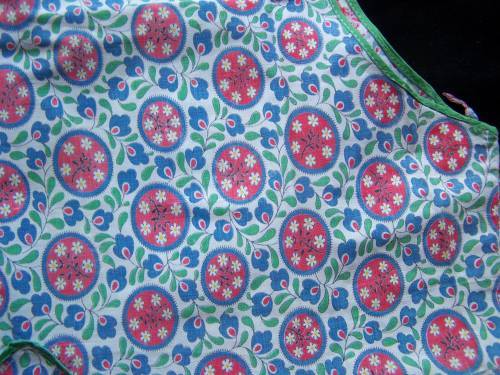
This week I have bought a couple of boxes at auction that contained everything you need for the well dressed woman of the 1940's!  A couple of bungalow dresses or aprons...   these would have been worn as a dress with maybe a sweater or blouse underneath during the morning in the house so that housework could be carried out. They would never have been worn by a respectable lady outside of the home. She would have always changed into smart clothes including gloves and hat when she went out to do the daily shopping or visiting.

It is quite easy to find sewing patterns to make bungalow dresses and they are simple to make however getting the correct fabric is a little harder - this one is a very typical 1940's print.

The box also had several 1950's hostess aprons - little dinky aprons so that you still look smart when your husband comes home from work and you have his supper on the table (and his slippers warming by the fire!).


Also several pairs of gloves - in all sorts of colours. Gloves, hat, shoes and handbag should always match!


                                               Long gloves for the evening

                                                         And always a hat.....

All perfect for re-enactment weekends, fancy dress or theatre productions. Or maybe just for that glamorous look when you go to the shops!